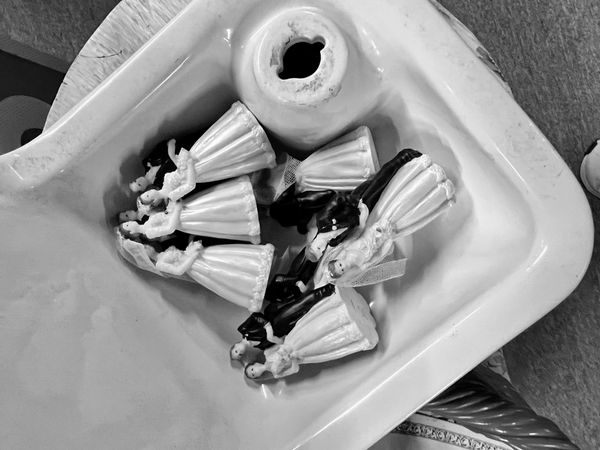

How to Leave the Business You've Built
Part Two in the "How to Leave" Series. An exploration of the dissolution of identity.

Years ago, I wrote:
“When the thing that once fed you begins to sicken you, it’s time to go.”
In 2025, I had two businesses, one that stemmed from two decades of marketing consulting, and one that was several years old that was attempting to build around horses and mental health.
In July of this year, I realized neither of them was working. So I dissolved the horse business, and I pivoted my consulting. It was a very painful process and I started to look for the stories of other women who had done the same.
When I went to find the stories of other women's experiences doing the same thing, but I could not find them. As someone who was letting her dream die, I knew that I could not be alone. The deeper I dug, the more evident it became that this post I’m writing needed to exist. Why? Because the stories of women walking away were almost non-existent.
The narratives of women owning their own businesses primarily spoke to the “joys” of building a business, falsely glorifying the mental stress of it all. Few spoke to the heartaches and challenges (misogyny, sexism, financial strain) that went with it. So the next piece in this series explores letting go of the business you've built.
Are you like me? You’re in your 40s, and for the last few years you’ve woken up with this nagging feeling that things aren’t quite right. And no, I’m not talking about the feelings of misalignment from the hellspace of menopause, but the business you’ve birth?
The business that felt like your calling, but now feels like something you carry rather than something that carries you? For me, the dream that once energized me now drains me in ways I didn't anticipate.
And the self-knowledge that emerges through years of pouring your heart into something creates new criteria for how you spend your growingly finite energy, and enterprises that once felt essential may no longer align with who you're becoming.
The Psychology of Pouring Everything Into Something
Whether it’s a side hustle or a business you scaled to seven figures, you know that building something from nothing demands a particular kind of investment that goes beyond money or time. It requires you to pour your soul into something, to weather storms that would sink most people, to absorb an unseen toll that accumulates over years of carrying responsibility for something bigger than yourself.
At first, the birth of your dream feels intoxicating: every decision reflects your vision, every success validates your instincts, and every crisis becomes personal. You work sixteen-hour days because everything depends on your personal investment, and its survival feels identical to your own.
But the storms come: economic downturns, difficult clients, cash flow crises, staff turnover, equipment failures, supply chain disruptions. Each challenge requires you to dig deeper, spend more, work longer, sacrifice more personal time and energy. What started as passion becomes a relentless demand for your life force, your financial resources, your emotional bandwidth.
Years pass, and you realize the business has become something that no longer feeds you, but feeds on you. The energetic expenditure required to maintain and grow it exceeds what it returns to your life. You're not building a dream anymore but sustaining something that demands increasing sacrifice from an older, more tired version of yourself.
Consider: When did your business stop energizing you and start draining you? What does it actually cost you now to keep this thing alive?
Recognizing the Unseen Toll
Somewhere in the five year mark (the adage of burn or bore out), your breaking point accumulates through small recognitions. Sunday evening dread that replaced excitement about Monday's possibilities. Calculating every business expense against personal needs. The realization that you haven't taken a real vacation in years because the business can't function without your constant attention.
At nearly 40 or 50, tolerance for a life out of balance wanes. You become acutely aware of time and energy as finite resources, and the cost-benefit analysis of maintaining something that demands everything starts to shift. The passion that once made long hours feel meaningful now makes them feel like slow exhaustion.
Also, the financial reality becomes impossible to ignore. Every dollar reinvested in growth is a dollar that becomes unavailable for your own security. You start to recognize the echo in the halls, the feeling that you're going through motions rather than pursuing a vision. Here’s where you give yourself permission to pause, and yourself if you want to continue on, or if there’s something else that may be better for yourself.
Reflect: What is this business actually costing you in energy, money, and life force? What would it feel like to have an easier life, to enjoy just being you for a while?
The Tension Between Investment and Well-Being
The wrestling that accompanies this recognition reveals how sunk cost psychology works against founder intuition. The voice in your head catalogs everything you've invested: years of work, financial resources, relationships built, reputation established. How can you walk away from something you've poured so much into?
The “practical” considerations feel enormous because they are enormous. This business may be your primary income source, your retirement plan, your children's inheritance. The identity you've built around being a founder carries weight, and admitting that what you built no longer serves you feels like admitting failure.
And let's be real, the deeper conflict exists between attachment to what you've created and honesty about what you actually need now. But here’s where you need to once again give yourself massive grace, the person you are now has different capacity, different priorities, and a different tolerance for the demands that running a business requires. And to make you laugh just a little, as I know this excavation is painful, you have less tolerance for bullshit.
Explore: What stories do you tell yourself about what you owe to this business? How much of your resistance to stepping away comes from fear of financial loss versus genuine love for the work itself?
Understanding That Letting Go Isn't Failure
The waters around business and your identity are probably muddy because of how intertwined they are. Take a moment to pause and let the sediment settle to the bottom of the stream so you can see clearly. Once the particles settle, you’ll see that letting go can be a leap of faith toward personal well-being and happiness. The business accomplished what it was meant to accomplish during the season when you needed exactly what it offered — a vehicle for your creativity, a way to prove your capabilities, a source of income and purpose during years when both were necessary.
Stepping away from something you built requires trusting that you are more than your business, that there are many other chapters ahead. The venture that launched your career doesn't have to be the one that sustains your later years. Choosing well-being over achievement is wisdom.
Notice: What would your life look like if you didn't have to carry this business anymore? What becomes possible when you stop pouring your life force into maintaining something that demands everything?
What Happens When You Let the Dream Die
As I said either, “The Founder” you started as on this journey isn't the same person considering whether to continue it. The process has its own beauty. The company you created you may sell to someone who shares your vision, and that means you can continue to watch your creation continue under fresh energy.
Or if you choose to close it, even dissolution can feel generous when it means releasing yourself, and everyone who's been a part of it, to pursue what fits their current lives. At the end of this process, you will discover what you actually want to do with your time when it belongs to you again. And what you find may surprise you.
It’s our right as women to be able to come home to themselves, whenever we need to. At the end of this piece, if you still need permission to let go of the business you’ve built – I’m giving it to you if you can’t give it yourself.
Written by
What's Next?