

The Way You Speak to Yourself Matters
How to identify harmful thought patterns to create a more compassionate, holistic view of yourself

"I'm just not good enough."
"Everyone else seems to handle this better than me."
"Why can't I keep up?"
Sound familiar? That voice in your head has quite a lot to say, doesn't it?
Years ago, on a road trip around California, I wandered into a small boutique with beautiful clothing. I remember standing in the changing room, realizing a dress in my usual size 4 wouldn't zip up.
After years of struggling with body image — having once been a size 22 before losing 117 pounds to end up at a size 2 by literally starving myself — this seemingly small change triggered by menopause felt catastrophic to me.
I broke down crying right there in the dressing room, confessing my whole history to the shop owner. She listened without judgment as I sobbed over what felt like losing control of my body again. The fact that I'd gained just 12 pounds felt, to my distorted perception, like I was somehow failing.
She quietly held space for my pain. Later, as I was leaving, she handed me my purchase in a bag where she'd written:
"The way you speak to yourself matters."
Those seven words hit me harder than any self-help book I'd ever read, because they came from someone who'd witnessed my vulnerability and responded with kindness rather than dismissal.
What's Really Happening When We Talk to Ourselves
That constant narration in your head that feels like it's running on autopilot — always commenting on everything you do, see, or feel — that's your self-talk. When this internal dialogue becomes negative, it typically falls into one of these patterns:
- Filtering: You magnify the negative aspects of a situation and filter out all the positive ones. Like focusing exclusively on the one criticism in your performance review while dismissing all the praise.
- Personalizing: You blame yourself for everything that goes wrong. The project deadline gets pushed back, and you automatically assume it's because your contribution wasn't good enough.
- Catastrophizing: You expect the worst-case scenario to happen. A minor mistake becomes evidence that everything will fall apart, and you'll face dire consequences.
- Polarizing: You see things as only good or bad, with no middle ground. You're either perfect or a complete failure, with no recognition of the complex reality between these extremes.
Why Do So Many of Us Speak Negatively to Ourselves?
Your mind plays a crucial role in generating negative thoughts, often as a means of self-protection. We are hardwired to think negatively due to the "negativity bias," an evolutionary trait that helped our ancestors stay alert to dangers and survive. This bias causes our brains to focus more on negative experiences and information, which can lead to negative self-talk as a way to prepare for and avoid potential threats or failures.
Consequently, this protective mechanism can become a habit, fostering a harsh inner dialogue that limits our self-belief and personal growth. Additionally, societal pressures and cultural norms often emphasize perfectionism and self-criticism, making it easier to fall into the trap of negative self-talk. Here's a closer look at how your mind works and what it may be trying to protect you from:
- Evolutionary Perspective: From an evolutionary standpoint, humans are hardwired for survival. Our ancestors needed to be on constant alert for dangers in their environment. This vigilant mindset has carried over into modern times, even though the threats we face today are often more psychological than physical. As a result, your brain tends to focus on negative information as a survival mechanism. This is known as the "negativity bias."
- Fear of Failure: One of the brain's main goals is to protect you from failure. Negative self-talk often stems from a fear of failing or making mistakes. By criticizing yourself, your brain attempts to prevent you from taking risks that might lead to failure. However, this protective mechanism can also hold you back from pursuing your goals.
- Social Comparison: Humans are social creatures, and comparing ourselves to others is a natural part of social interaction. Negative self-talk can arise when you perceive yourself as less successful, attractive, or capable compared to others. This social comparison can trigger feelings of inadequacy and self-doubt.
- Internalized Criticism: Throughout your life, you've likely received criticism. Over time, these external criticisms can become internalized, leading to a harsh inner critic. Your mind uses this internal criticism to try and motivate you to improve or avoid making mistakes, but it often ends up being more harmful than helpful.
- Self-Protection: Negative self-talk can be a misguided attempt at self-protection. By criticizing yourself before others do, you might feel you're preparing for potential rejection or disappointment. This preemptive self-criticism is intended to cushion the blow, but it often just makes you feel worse.
How do you reframe negative thoughts so that they don't have so much control over the way you think?
Reframing is about consciously changing how you perceive and interpret your thoughts and experiences. It involves challenging negative beliefs and replacing them with more realistic and compassionate ones. The key to reframing lies in recognizing and questioning your automatic negative thoughts. These thoughts often stem from self-doubt, fear, or past experiences.
By acknowledging and challenging them, you can gain a fresh perspective and create space for more positive and self-affirming beliefs. When you shift your focus from yourself to others or the world at large, you're more likely to ignore self-criticism and become more patient, self-compassionate, and open to self-improvement or seeking help from others.
Making Friends with Your Mind
Changing your relationship with negative self-talk isn't about silencing that voice completely. It's about recognizing when it's speaking, questioning what it's saying, and choosing whether to believe it. Here's an evidence-based approach from Cognitive Behavioral Therapy (CBT) that I've found particularly helpful:
Catch It, Check It, Change It: How to Reframe Your Thinking
This three-step process is a cornerstone of CBT, a therapeutic approach with strong clinical evidence for addressing negative thought patterns. It works by helping us identify automatic thoughts, evaluate their accuracy, and develop more balanced alternatives:
- Catch it: Identify the thought behind your feeling. Notice what you're telling yourself in that moment of distress.
- Check it: Assess the accuracy and helpfulness of the thought. Is this thought based on facts or assumptions? Would you apply this same standard to someone else?
- Change it: Replace the negative thought with a more accurate and helpful one. What would a compassionate friend say in this situation?
Here's a thought record with examples to help you work through what you're thinking:
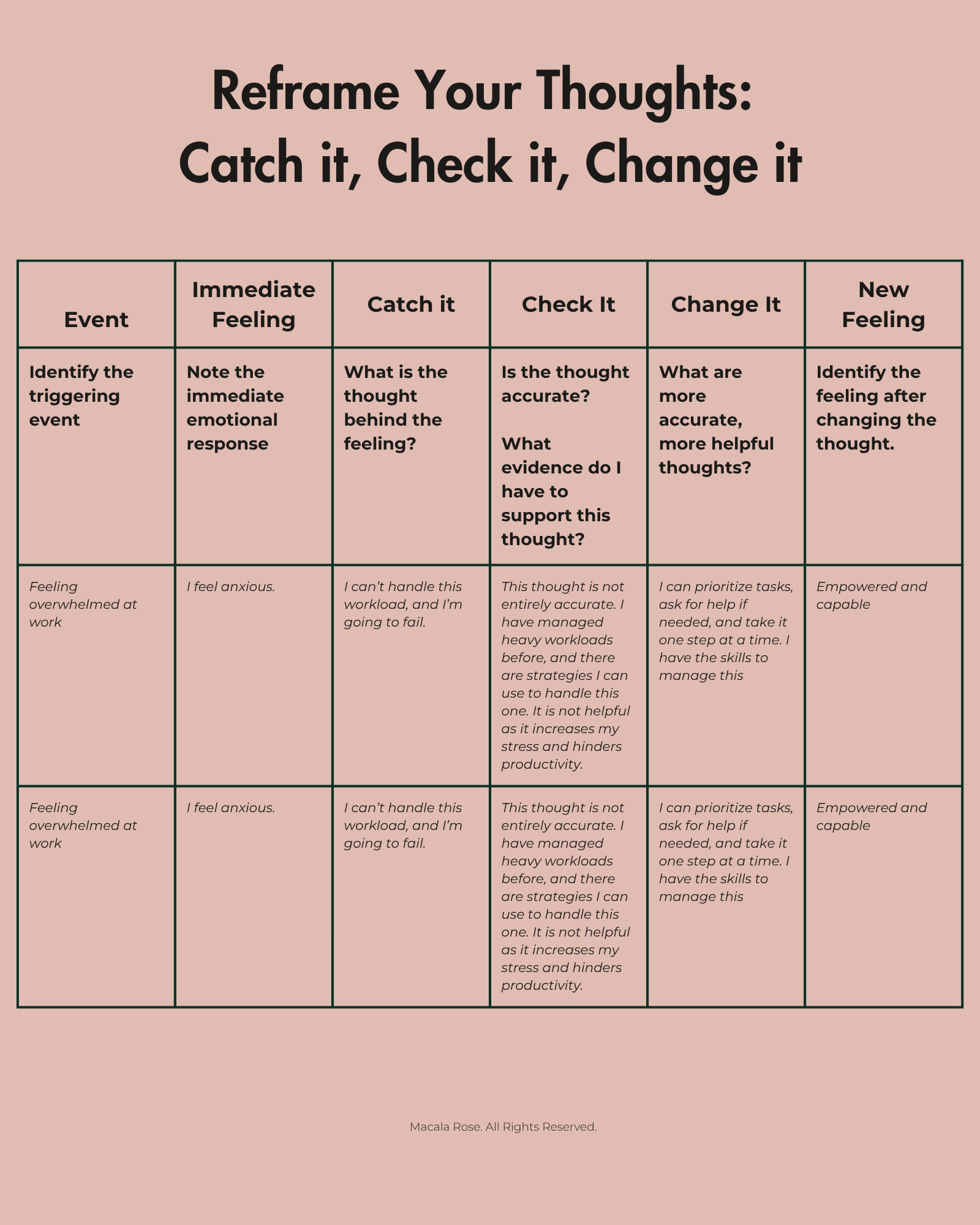
The Way You Speak to Yourself Truly Matters
The woman who wrote on my shopping bag gave me a gift that day, a reminder that the voice in my head isn't always telling the truth. I've learned that we often accept our harshest self-assessments without question, even when we'd never apply such rigid standards to others.
The way you speak to yourself matters precisely because you're listening. You spend more time with your own thoughts than with anyone else in your life. And just as you deserve to live and work in environments free from harmful criticism, you deserve an internal dialogue that recognizes both your humanity and your inherent worth.
Written by
What's Next?



The Attention You Stopped Paying Yourself
How to Be Human, Part II — A Three-Part Series on How Women Have Lost Our Humanity Self-awareness has never been widespread. Human beings have always struggled to confront their internal contradictions, their fears, the grief they’d rather not name. That work requires space, time, and a tolerance for discomfort that most of us were never taught. But the forces working against it now are more organized, more sophisticated, and more relentless than anything previous generations faced. The attent